
MENU Cart
EN
Soriphar guarantees the quality and effectiveness of its products
Free shipping from € 75
Collagen

Collagen: the structure behind firm skin, hair and nails

Collagen is the most abundant protein in your skin. What it does, why it declines and what research says about collagen peptides and the substances that work with them.

28
different types of collagen in the body
±1 %
less collagen production per year, from about age 25
300.000
daltons: that is the size of an unprocessed collagen molecule
< 2.000
daltons: the size of hydrolysed collagen peptides
In the skin

What collagen does in your skin

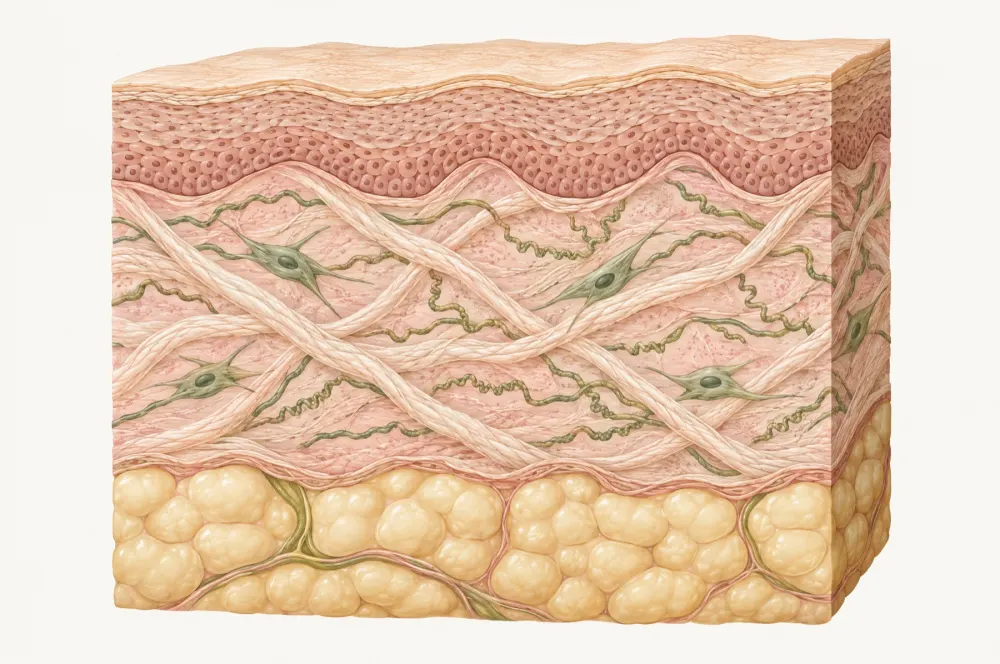
Together with elastin and hyaluronic acid, collagen forms the extracellular matrix of the dermis, the middle layer of the skin. Three chains of amino acids wind around each other in a triple helix there and bundle into strong fibres.

  • Gives the skin firmness and mechanical strength
  • Supports elasticity and resilience, together with elastin fibres
  • Works with fibroblasts, the cells that make new collagen
  • Influences hydration through hyaluronic acid in the matrix
Cross-section of the skin with collagen and elastin fibres in the dermis Epidermis Dermis Hypodermis
Collagen and elastin fibres form the dermis together with fibroblasts.
Ageing

Why collagen declines

From about the age of 25 collagen production falls by around 1 % a year. External factors speed up that breakdown, and the result shows in skin that becomes less dense, less firm and drier.

  • UV radiation
  • Air pollution
  • Oxidative stress
  • Hormonal changes
  • Too few building blocks from food
Collagen production by age
100% 25
90% 35
80% 45
70% 55
60% 65

Indicative: production compared with age 25, assuming about 1 % less per year.

Absorption

Hydrolysis makes collagen absorbable

Unprocessed collagen, such as gelatine, is a large molecule of about 300,000 daltons. Enzymatic hydrolysis cuts it into peptides of less than 2,000 daltons. Research therefore looks at hydrolysed peptides, and at di- and tripeptides such as prolyl-hydroxyproline that can be found in the blood after intake.

Unprocessed collagen ± 300.000 Da
Collagen peptides < 2.000 Da
  • Smaller fragments than unprocessed collagen
  • Studied for absorption through the gut
  • Di- and tripeptides measurable in the bloodstream
Complementary

Collagen does not work alone

Collagen naturally contains few sulphur-containing amino acids such as cysteine, and those are exactly what your hair needs. Without cofactors, collagen formation also proceeds less well. That is why the formulas studied combine structural proteins with their cofactors.

Collagen peptides

Building blocks and a signal for fibroblasts, for a firm dermis.

How it was studied

5 g of collagen peptides a day, 8 to 12 weeks, double-blind and placebo-controlled. Measured on hydration, elasticity and wrinkle depth.

Duteil et al., 2016; 2018
Hyaluronic acid

Binds water in the matrix and supports volume and elasticity.

How it was studied

120 mg a day, 12 weeks, double-blind and placebo-controlled. Measured on skin hydration and wrinkle depth.

Hsu et al., 2021

Cysteine

Sulphur-containing amino acid for keratin and the disulphide bridges that make hair strong.

How it was studied

5 g of fish collagen peptides with 500 mg of L-cystine a day, randomised and placebo-controlled. Measured on skin quality.

Perin et al., 2025

Keratin

The structural protein of hair and nails, rich in cysteine.

How it was studied

500 mg of keratin hydrolysate a day, randomised and placebo-controlled. Measured on hair strength, hair thickness and nail quality.

Tursi et al., 2025

Grape seed extract

Proanthocyanidins (OPCs) that protect collagen and elastin fibres against oxidative stress.

How it was studied

100 mg of proanthocyanidins a day, randomised and placebo-controlled. Measured on skin condition and oxidative stress.

Yamakoshi et al., 2004

Cofactors

Vitamin C contributes to normal collagen formation for the normal function of skin. Zinc and biotin contribute to the maintenance of normal skin, copper to the maintenance of normal connective tissues.

How it was studied

Collagen peptides with vitamin C (60 mg), zinc (10 mg) and biotin (50 µg) a day, randomised and placebo-controlled. Measured on skin elasticity.

Czajka et al., 2018

We describe how the studies were set up, not what you may expect for yourself. Food supplements do not replace a varied diet.

Sources (10)
  1. Duteil L, Queille-Roussel C, Lacour JP, Montastier C. Effect of a fish collagen peptide supplementation on skin aging: clinical and instrumental evaluation. J Aging Res Clin Practice. 2016;5(2):84–92.
  2. Duteil L, Queille-Roussel C, Lacour JP, Montastier C. Effect of low dose type I fish collagen peptides combined or not with silicon on signs of skin ageing. J Clin Cosmet Dermatol. 2018;6(4):555692.
  3. Hsu TF, Su ZR, Hsieh YH, et al. Oral Hyaluronan Relieves Wrinkles and Improves Dry Skin: A 12-Week Double-Blinded, Placebo-Controlled Study. Nutrients. 2021;13(7):2220.
  4. Perin F, Bruno-Bonnet C, Soulard JP, et al. Effects of Oral Fish Collagen and l-Cystine on Skin Ageing in Mature Women and Skin Imperfections in Young Women. Cosmetics. 2025;12:188.
  5. Tursi F, Nobile V, Cestone E, et al. The Effects of an Oral Supplementation of a Natural Keratin Hydrolysate on Skin Aging. J Cosmet Dermatol. 2025;24(1):e16626.
  6. Yamakoshi J, Sano A, Tokutake S, et al. Oral intake of proanthocyanidin-rich extract from grape seeds improves chloasma. Phytother Res. 2004;18(11):895–9.
  7. Czajka A, Kania EM, Genovese L, et al. Daily oral supplementation with collagen peptides combined with vitamins and other bioactive compounds improves skin elasticity. Nutr Res. 2018;57:97–108.
  8. Rinnerthaler M, Bischof J, Streubel MK, Trost A, Richter K. Oxidative stress in aging human skin. Biomolecules. 2015;5(2):545–589.
  9. Krutmann J, Bouloc A, Sore G, Bernard BA, Passeron T. The skin aging exposome. J Dermatol Sci. 2017;85(3):152–161.
  10. Emmerson E. Extracellular matrix in skin aging and repair. Biogerontology. 2012;13(1):3–20.

Stay in the loop

New insights in your inbox, clearly explained and backed by evidence. No offers without substance.

Privacy Overview

This website uses cookies so that we can provide you with the best user experience possible. Cookie information is stored in your browser and performs functions such as recognising you when you return to our website and helping our team to understand which sections of the website you find most interesting and useful.